
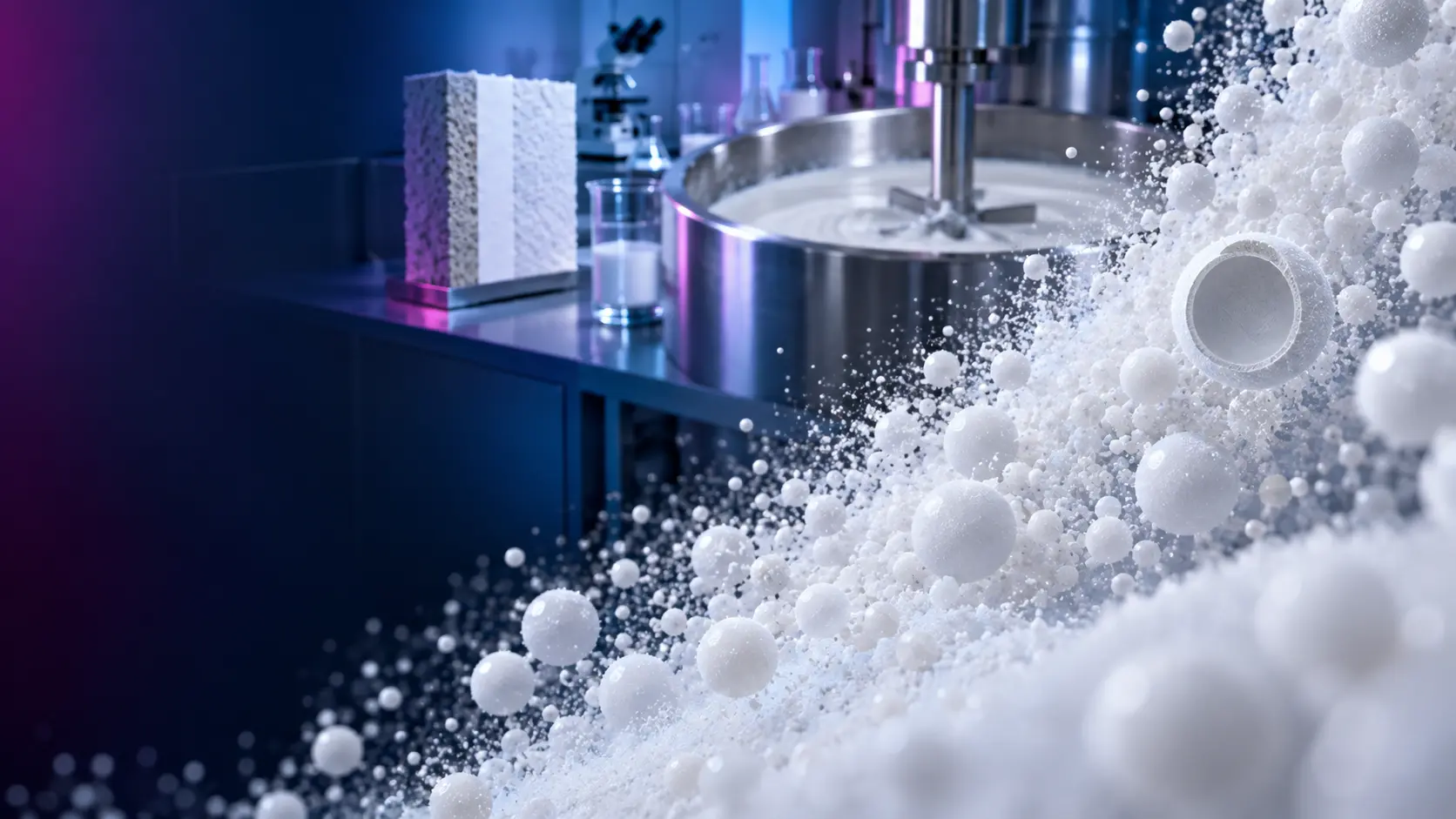
Hollow Glass Microspheres
Lightweight Functional Fillers

HOLLOW GLASS MICROSPHERES

Water-insoluble soda-lime-borosilicate glass bubbles engineered to reduce composite weight, lower thermal conductivity, control resin demand and survive selected processing conditions.

Low Density Thermal Insulation Resin Reduction High Crush Strength

Balance density, strength and processing

Choose the lowest-density grade that can tolerate the pressure and shear generated during mixing, pumping, extrusion, moulding or final service.

01 · DENSITY

Define the lightweighting target

Lower true density provides greater weight reduction, but the selected grade must also survive processing and service loads.

02 · CRUSH STRENGTH

Match the pressure environment

Use higher-strength grades for aggressive mixing, thermoplastic extrusion, injection moulding or pressure-loaded syntactic systems.

03 · PARTICLE SIZE

Consider finish and flow

Particle size influences surface finish, packing, viscosity response and suitability for thin sections or fine features.

Seven performance grades

Ultra-Low Density ↗

3M™ Glass Bubbles K1

Lowest-density grade in the published range for thermal-insulation plasters, low-stress caulks and lightweight coatings.

True Density 0.125 g/cm³
Crush Strength 250 psi
D50 65 µm
Positioning Maximum weight reduction
General Lightweighting ↗

3M™ Glass Bubbles K15

General-purpose low-density filler for resin systems, automotive body putties, lightweight caulks and pourable polyurethane compounds.

True Density 0.15 g/cm³
Crush Strength 300 psi
D50 60 µm
Positioning Pourable resin filler
Surface Modified ↗

3M™ Glass Bubbles K15 HSN

Surface-treated grade positioned for improved wet-out, dispersion and interfacial adhesion in organic resin systems.

True Density 0.15 g/cm³
Crush Strength 300 psi
D50 60 µm
Surface State High-nitrogen silane treated
Balanced Strength ↗

3M™ Glass Bubbles K37

Medium-pressure grade for dry-mix construction mortars, sheet-moulding compounds and structural adhesives.

True Density 0.37 g/cm³
Crush Strength 3,000 psi
D50 45 µm
Positioning SMC/BMC and mortars
High Strength-to-Density ↗

3M™ Glass Bubbles S28HS

Lightweight high-strength grade for self-levelling epoxy screeds, elastomeric roof coatings and tile grouts.

True Density 0.28 g/cm³
Crush Strength 3,000 psi
D50 30 µm
Positioning Flooring and coatings
Ultra-High Strength ↗

3M™ Glass Bubbles iM16K

High-strength grade developed for demanding thermoplastic processing, injection moulding and deepwater insulation syntactics.

True Density 0.46 g/cm³
Crush Strength 16,000 psi
D50 20 µm
Positioning High-pressure processing
Extra-Low Density / High Strength ↗

3M™ Glass Bubbles XLD 3000

Low-density 3,000 psi grade positioned for automotive lightweighting, structural sealants and aerospace components.

True Density 0.23 g/cm³
Crush Strength 3,000 psi
D50 30 µm
Positioning Automotive and aerospace

More than simple density reduction

The spherical, hollow glass structure affects formulation weight, flow, resin demand, thermal performance and dimensional response.

True Density Reduction

Low-density glass bubbles displace heavier resin or conventional mineral filler to reduce finished composite weight.

Resin Demand Control

Smooth spherical surfaces have lower surface area than irregular fillers, supporting efficient resin wet-out.

Flow & Processing

The spherical shape provides a ball-bearing effect that can improve flow in suitable liquid formulations.

Thermal Performance

The hollow structure supports lower thermal conductivity in insulation coatings, syntactics and composite systems.

Dimensional Stability

Isotropic spheres avoid directional fibre orientation and support uniform dimensional behaviour.

Strength Selection

The portfolio spans low-pressure lightweighting through 16,000 psi high-pressure processing grades.

Lightweighting across nine industries

Lightweighting across nine industries

Published application areas for 3M™ Glass Bubbles.

01

Energy

Subsea insulation, syntactic risers, low-density drilling fluids and cryogenic tanks.

Subsea Syntactic Foam
02

Manufacturing

Injection moulding, thermoplastic extrusion, synthetic foams and resin reduction.

Extrusion Thermoplastics
03

Automotive

SMC/BMC panels, sealants, underbody coatings and EV battery potting.

SMC/BMC EV
04

Transportation

Aerospace syntactics, marine composites, commercial vehicles and rail interiors.

Aerospace Marine
05

Construction

Reflective roof coatings, spackling, joint fillers, plasters and concrete.

Roof Coatings Plasters
06

Electronics

Low-dielectric potting, 5G housings, radar-transparent enclosures and encapsulation.

Potting 5G
07

Commercial

Epoxy flooring screeds, cultured marble, decorative panels and maintenance products.

Flooring Cultured Marble
08

Healthcare

Prosthetic composites, orthotic compounds, medical housings and dental syntactics.

Prosthetics Medical
09

Safety & Industrial

Emulsion-explosive sensitisation, mitigation foams and thermal protective insulation.

Explosives Protection

Density vs. crush strength

Published values from the supplied category page.

Grade Target True Density Isostatic Crush Strength Particle Size D50 Published Positioning
K1 0.125 g/cm³ 250 psi (1.7 MPa) 65 µm Ultra-lightweight density reduction
K15 0.15 g/cm³ 300 psi (2.1 MPa) 60 µm General pourable resin filler
K15 HSN 0.15 g/cm³ 300 psi (2.1 MPa) 60 µm High-nitrogen silane surface treated
K37 0.37 g/cm³ 3,000 psi (20.7 MPa) 45 µm Medium-pressure SMC/BMC and mortars
S28HS 0.28 g/cm³ 3,000 psi (20.7 MPa) 30 µm High strength-to-density for flooring
iM16K 0.46 g/cm³ 16,000 psi (110 MPa) 20 µm High-pressure moulding and deepsea applications
XLD 3000 0.23 g/cm³ 3,000 psi (20.7 MPa) 30 µm Extra-low density for automotive and aerospace

Values are typical or target values. Confirm the current 3M technical data sheet, processing limits and availability before specification.

Practical selection and processing

Practical selection
and processing

Which grade is positioned for high-pressure injection moulding?
iM16K has the highest published crush strength in this range at 16,000 psi and a D50 of 20 µm.
What distinguishes K15 HSN from K15?
The page lists the same density and crush strength for both grades, while K15 HSN has a surface treatment intended to improve wet-out and dispersion in organic resins.
How should glass bubbles be added during mixing?
The source recommends adding them near the end of the mixing cycle at lower impeller speed to reduce shear damage.
How is the final grade chosen?
Balance density reduction against process pressure, shear, particle size, surface finish and the mechanical demands of the finished part.

Need Our Services?

Call: +91 97695 93030

Work Hours

Mon – Sat: 9:00 AM – 6:00 PM IST

Email Us

support@geoconproducts.com