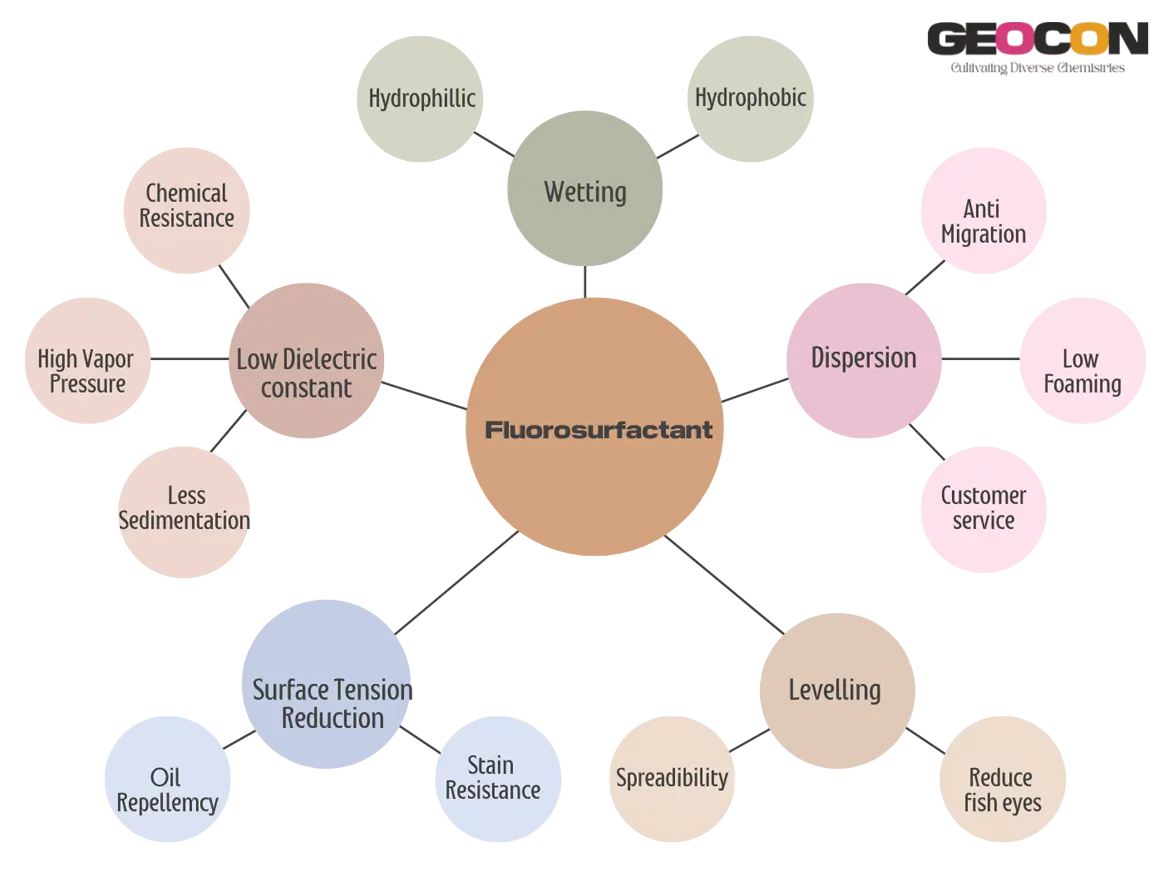
Fluorosurfactant
The Smarter Additive for Paints & Coatings
Smaller & Effective

Fluorosurfactant is (Fluorinated Surfactant) a surfactant that contains a Fluorine Group. Fluorosurfactant is the only Surfactant today available globally can reduce or lower the surface tension with very small addition in various water and solvent borne coating, ink and sealant systems. In comparison with other Oil based, hydrocarbon and silicone or Siloxane surfactants there are numerous advantages of Fluorosurfactant over these.
This is mainly because the atomic radius of the fluorine atom is slightly larger than that of the hydrogen atom and therefore a high electronegativity of the fluorine atom create the formation of a strong carbon-fluorine bond and this makes lowering surface tension dramatically less.
Due to lowering surface tension less than 20 dynes in coating system it offers substrate wettability, Dispersion Organic pigments in water borne resins, Levelling of solvent less systems more effective way.
The best examples of the fluorosurfactant of the addition type includes coating and ink, floor wax, AFFF, Photographic emulsion, Cleaning & Degreasing Agent, Soldering Paste, Epoxy and Polyurethane Floor coatings etc.

Fluorosurfactant Grades offered
(Please click on the image to get more details on the products)

Fluorosurfactant are effective wetting agents
In Paint and Coating processing Fluorosurfactant offered in both Solvent and Water borne coatings. The main objective of Fluorosurfactant is to improve substrate or surface wetting to great extent especially substrate like metals, plastics and others have issues. When we compare with other hydrocarbon or silicone wetting agents the efficiency is beyond comparable.
Example for a liquid to be able to spread and wet the surface of a solid, the surface tension of the liquid must be lower than that of the surface.
The following table shows a comparison of surface tension of several substrates, measured in mN/m:
| Brick wall | 75 |
| Glass | 73 |
| Stainless Steel | 43 - 46 |
| PVC | 39 - 42 |
| Polystyrene | 39 - 42 |
| Polyethylene | 32 - 39 |
| Polypropylene | 28 |
Using Fluorosurfactant help to reduce surface tension below 20 mN/m so that very low surface tensions are wetted efficiently.
Even though the cost price of Fluorosurfactant are expensive than hydrocarbon or silicone additives the required quantities to be used in coatings, ink and sealant are significantly lower as a result economy of the cost per liter is always been considered when compared with process and product benefits.
The other advantages of Fluorosurfactant are-
- Wetting of non-polar Surfaces
- Wetting & Dispersion additive for Organic, Inorganic and metallic pigments
- Remove flooding effects
- Eliminate cratering
- Less Foaming
- Improve levelling & gloss
- Stable in high and low pH level
- Stable in high and low temperatures

Applications of Fluorosurfactants
- Water & Solvent borne coatings & inks
- Water & Solvent borne Sealants
- Floor Coatings Wax
- Photographic Emulsion
- AFFF (firefighting foam)
- Glass Cleaner
- PTFE Non-Stick Coatings
- Soldering Paste
- PVC Plastisol
- PU Pigment paste
- Diamond Fillers & Coatings
- Precious Sone and Diamond Coatings
- Natural Stone Coatings, Fillers, and Converters
- Electronic Coatings on PCB
- Nano Coatings
- Textile Finishing
- Industrial Floor Degreaser & cleaner
- Oil well chemicals
- Mold releasing compounds
- Anti-Fouling formulations
- Anti-Graffiti formulations
Comparison between Fluorosurfactant and Hydrocabon/Silicones
Fluorosurfactants are made with 2 main properties Hydrophilic head and highly Hydrophobic tail. Fluorocarbons have been always outstanding properties due to its Fluorine atom. The specific properties of Fluorine chain in Fluorosurfactant as compared to hydrocarbon & silicone surfactant distinguished by its performance in terms of substrate wetting, dynamic surface tension or contact angle and spreading. The properties are mentioned in the following table.